37-Gallon Dual-Chamber Compost Tumbler: Roll & Aerate
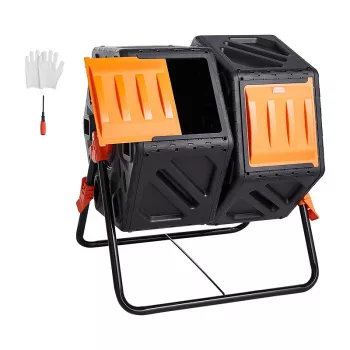
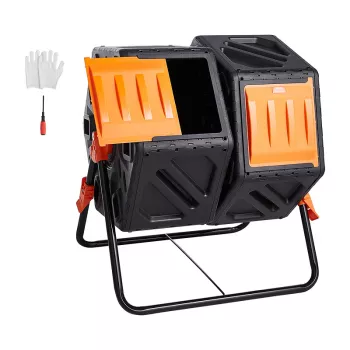
37-Gallon Dual Chamber Compost Tumbler with Easy Rolling and Airflow
A dual-chamber compost tumbler streamlines composting by letting one side finish while the other is filled. With easy rolling for frequent turning and built-in airflow, a 37-gallon model can help speed breakdown, reduce odors, and keep kitchen and yard scraps moving toward usable compost.
What a dual-chamber tumbler changes in everyday composting
The biggest upgrade with a dual-chamber design is continuity. Instead of restarting the process every time fresh scraps arrive, you keep compost “in rotation”—one chamber actively breaking down material while the other is accepting new inputs.
- Keeps compost moving: one side “cooks” while the other is being loaded, so you aren’t stuck waiting on a single batch.
- Helps prevent stalls: adding cold, wet scraps to an almost-finished batch can drop temperatures and slow microbes; separate chambers reduce that problem.
- Makes turning practical: tumbling mixes moisture and oxygen without a pitchfork, which is especially helpful for smaller yards or patios.
- Encourages a repeatable routine: clear separation makes it easier to follow simple habits (add, balance, roll, repeat).
Capacity and footprint: what 37 gallons means in practice
A 37-gallon dual-chamber tumbler fits many small-to-medium households that produce steady kitchen scraps plus seasonal yard trimmings. Because that capacity is split into two compartments, it also nudges you toward better composting fundamentals: leaving enough headspace for mixing and airflow instead of packing everything tight.
Plan for level placement, easy access to the doors, and enough clearance to roll/turn comfortably. When the batch has room to tumble and breathe, it’s more likely to heat up and stay active—two ingredients for faster, more consistent results.
| Household / garden situation | Typical inputs | How to use the two chambers |
|---|---|---|
| Apartment or small household with limited yard waste | Mostly kitchen scraps + small amounts of shredded paper | Fill one side slowly; keep the other finishing longer for maturity |
| Small family with regular cooking | Daily food scraps + occasional leaves/grass (dried first) | Alternate chambers monthly to maintain a steady compost supply |
| Garden-heavy season | More browns (leaves) + some greens | Dedicate one chamber to leaf-heavy mix; keep the other for kitchen-heavy mix |
Easy rolling and turning: how to get the benefits without the hassle
Turning is where tumblers shine—because “a few quick rolls” is easier to do consistently than flipping a pile. Regular turning distributes oxygen and moisture, breaks up clumps, and helps prevent the sour, anaerobic pockets that can develop around dense food scraps.
- Turn frequency: aim for a few turns per week during active composting; as the batch finishes, turn less often so the compost can stabilize.
- After each addition: add scraps, add a matching amount of browns, then roll to spread moisture and minimize matting.
- Prevent wet pockets: frequent rolling helps break up heavy items (like melon rinds) before they turn slimy.
- If it’s hard to turn: the load is often too wet, too dense, or packed; add dry browns and avoid compressing the contents.
Airflow features: keeping compost aerobic and low-odor
Aerobic microbes (the “good” decomposers) work fastest when oxygen is available. Airflow plus turning supports those microbes and helps moisture evaporate at a steady pace, which is why ventilated tumblers tend to be cleaner and less smelly than sealed containers.
- Oxygen = faster breakdown: airflow supports active microbes and reduces the chance of rotten odors.
- Turning complements ventilation: airflow ports help, but tumbling is what redistributes oxygen through the whole batch.
- Balance matters: too much airflow with too little moisture can slow activity; aim for the “wrung-out sponge” feel.
- Fix odors at the source: add more browns and increase turning rather than relying on masking products.
For composting fundamentals and best practices, these references are reliable starting points: U.S. EPA—Composting at Home, Cornell Waste Management Institute—Composting Basics, and USDA NRCS—Composting.
A simple dual-chamber routine (week-by-week)
Dual chambers are easiest when each side has a job. One side is “active fill,” the other is “finish and cure.” That separation reduces guesswork and helps prevent the common mistake of constantly resetting the batch with fresh scraps.
Inputs: what to add, what to avoid, and how to balance browns and greens
Troubleshooting: common problems and fast fixes
Where this 37-gallon tumbler fits: ideal users and use cases
Product overview: 37-Gallon Dual Chamber Compost Tumbler with Easy Rolling and Airflow
The 37-Gallon Dual Chamber Compost Tumbler with Easy Rolling and Airflow is built around a continuous compost cycle: fill one chamber while the other finishes. Easy rolling encourages frequent turning, and airflow features support aerobic conditions for faster breakdown with fewer odors—especially when kitchen scraps are balanced with dry browns.
| Item | Detail |
|---|---|
| Product name | 37-Gallon Dual Chamber Compost Tumbler with Easy Rolling and Airflow |
| Availability | In stock |
| Price | $67.01 USD |
More in-stock picks
- Newborn Baby Gift Set – Bath Toys, Towels, Rattles & More
- 70cm Kawaii Animal Plush Pillow – Soft Seal, Shark & Narwhal Hugging Toy
- VVS Moissanite Long Tassel Drop Earrings
FAQ
How often should a compost tumbler be turned?
During active composting, turn it every few days (or a few turns per week), especially after adding new scraps. As the batch gets darker and more crumbly, reduce turning so it can finish and stabilize.
What should the moisture level feel like inside a tumbler?
Aim for the texture of a wrung-out sponge: damp but not dripping. If it’s soggy or smells sour, add dry browns; if it’s dusty and inactive, add a light mist of water and more greens.
Why does my compost tumbler smell bad even though it has ventilation?
Bad odors usually come from anaerobic pockets caused by excess moisture, too many greens, or compacted material. Add dry browns, tumble more frequently, and avoid packing the chamber so air can move through the mix.














Leave a comment