24-Inch Hand Swager: Clean Crimps on Copper & Aluminum
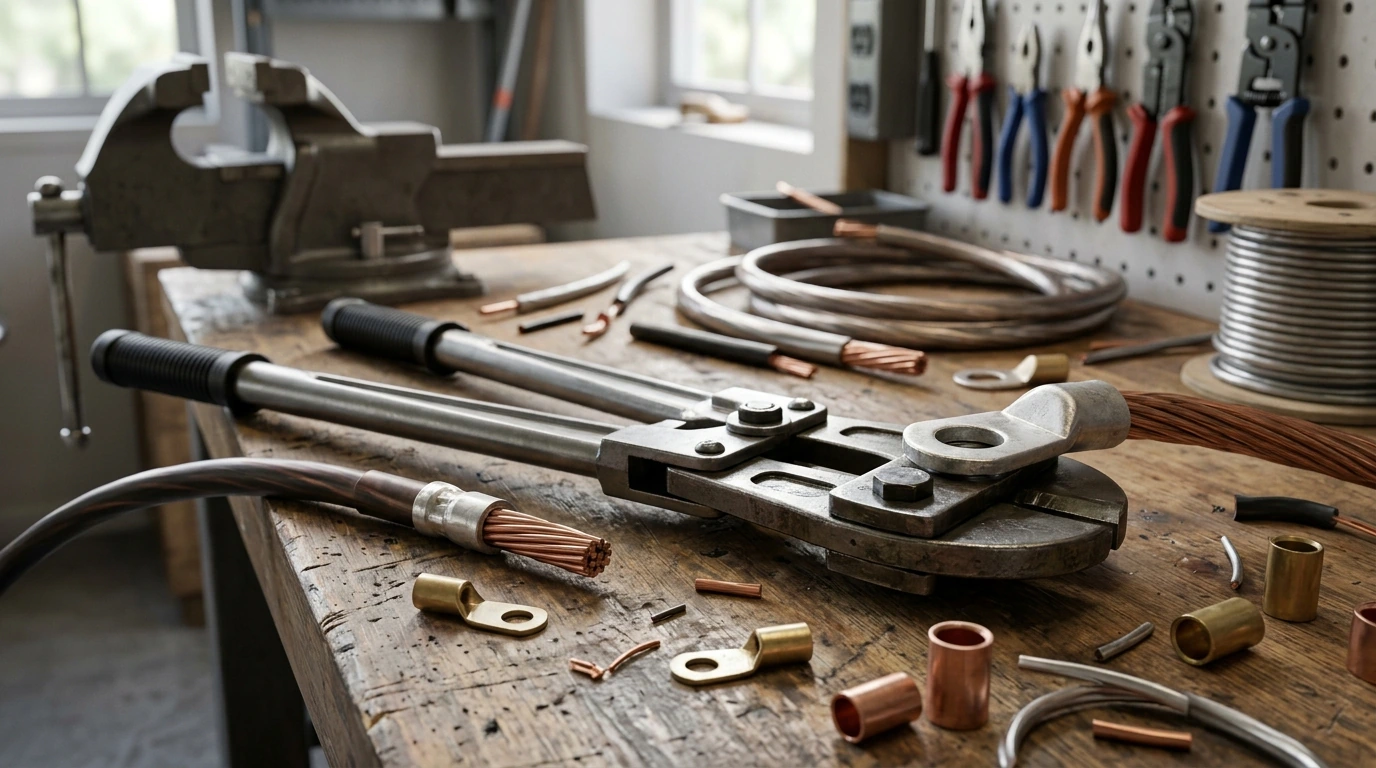
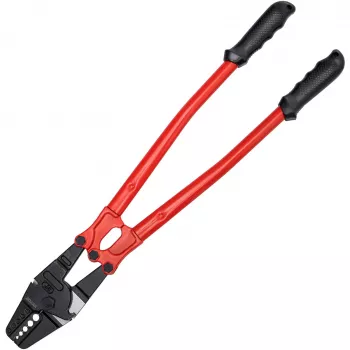
24-Inch Hand Swager Crimping Tool for Copper & Aluminum Wire
Reliable crimping matters when building or repairing cable runs, battery leads, ground straps, and utility connections. A long-handled swager provides extra leverage for consistent compression on copper and aluminum wire, helping create secure terminations with less effort and fewer re-dos. When the goal is a tight, low-resistance connection that holds up to vibration and daily use, a 24-inch hand swager is a practical, shop-friendly solution that doesn’t require a pump, battery, or power outlet.
What a 24-inch hand swager does
A 24-inch hand swager is a manual crimping tool designed to compress lugs and sleeves onto wire, forming a mechanically secure termination. The longer handles increase leverage, which helps create more uniform compression from crimp to crimp—especially useful when assembling multiple cables in a batch.
- Compresses lugs and sleeves onto wire to form a mechanically secure connection
- Uses long handles to increase leverage, improving consistency across repeated crimps
- Commonly used for electrical, automotive, marine, and workshop cable work where a solid crimp is preferred over solder
- Useful for field work where a powered hydraulic crimper is not practical
For standards and safe wiring practices, it’s helpful to reference recognized guidance such as NFPA 70 (National Electrical Code) and connector safety overviews like UL wire connector standards information.
Where it fits best: typical projects and users
Long-handled manual swagers are a strong match for hands-on builds where portability and simplicity matter. They’re commonly chosen by DIYers, boat owners, mechanics, and anyone who needs dependable cable terminations without investing in a dedicated hydraulic system.
- Battery and inverter cables: building or refreshing heavy leads and ring terminals
- Marine rigging and electrical: reliable terminations that tolerate vibration
- Automotive and off-road: winch wiring, auxiliary power distribution, grounding
- General shop maintenance: quick repairs and custom cable assemblies
For broader conductor and electrical application background, the Copper Development Association provides helpful material on copper use and electrical considerations.
Key features that affect crimp quality
Crimp quality isn’t only about force; it’s also about alignment, repeatability, and using the correct connector and crimp profile. A good manual swager should feel stable through the stroke and close consistently so the connector barrel deforms evenly rather than “pinching” on one side.
- Handle length and leverage: longer handles help achieve full compression with less hand strain
- Jaw alignment: stable, centered closure reduces uneven deformation of the lug/sleeve
- Die profile and compatibility: ensure the crimp shape matches the connector style being used
- Build and finish: smooth operation helps keep crimps repeatable across a batch of cables
- Portability: manual tools are easy to carry for on-site work
When comparing tools, it helps to think in terms of outcomes: does the tool consistently deliver a tight barrel compression without cracking, and can it do so comfortably across multiple terminations?
Copper vs. aluminum wire: practical considerations
Copper and aluminum both work well when terminated correctly, but they don’t behave the same at the connection point. Copper is generally more forgiving; aluminum typically requires closer attention to connector ratings and surface preparation to avoid long-term issues.
- Copper is generally more forgiving; aluminum often needs extra attention to connector rating and surface preparation
- Use connectors/lugs rated for the conductor material (copper-only vs. AL/CU dual-rated)
- For aluminum terminations, follow connector instructions regarding oxide inhibitor and torque on fasteners
- Match connector size to wire gauge; undersized or oversized lugs are a leading cause of weak crimps
Practical tip: if the wire slides into the barrel too easily with lots of space left over, or it barely fits and shaves strands, the lug size is likely wrong. Correct sizing is one of the fastest ways to improve both mechanical strength and electrical performance.
Step-by-step: making a solid crimp with a hand swager
| Step | What to verify | Why it matters |
|---|---|---|
| Connector match | Connector is rated for copper or AL/CU and fits wire gauge | Prevents overheating, loosening, and corrosion issues |
| Strip length | Conductor fully seats without exposed strands | Avoids weak contact and short risks |
| Crimp placement | Crimp lands on barrel area, not on tongue/palm | Improves mechanical hold and electrical contact |
| Full compression | Complete stroke; crimp looks even with no sharp cracks | Reduces resistance and improves reliability |
| Final protection | Insulation/heat shrink applied where appropriate | Helps against moisture, vibration, and abrasion |
Common mistakes and how to avoid them
Care, storage, and long-term performance
Product snapshot
For cable work where manual leverage is preferred, the 24-Inch Hand Swager Crimping Tool for Copper & Aluminum Wire is a straightforward option for building and repairing terminations without powered equipment. It’s also a convenient pick for field kits where portability matters.
Featured in-stock picks
- 24-Inch Hand Swager Crimping Tool for Copper & Aluminum Wire — $57.82 (In stock)
- VVS Moissanite Long Tassel Drop Earrings — $45.51 (In stock)
FAQ
Can the same crimping tool be used for both copper and aluminum wire?
Yes, as long as the connector is rated for the conductor material (use AL/CU dual-rated lugs where needed). Aluminum terminations typically require careful cleaning/prep and following the connector’s instructions for inhibitor and fastening.
How can a finished crimp be checked without special test equipment?
Check that the compression is uniform, placed on the barrel (not the tongue), and shows no cracking. Then perform a firm pull test; if strands slip or the barrel deforms oddly, redo the termination with the correct connector and placement.
When is a 24-inch manual swager a better choice than a hydraulic crimper?
A 24-inch manual swager is a good fit for portability, occasional use, quick field repairs, and simple shop builds. Hydraulic crimpers tend to be better for very high volume work or very large cable sizes where repeatable high force is required.














Leave a comment