Build a 3D Wooden Stagecoach Music Box Model
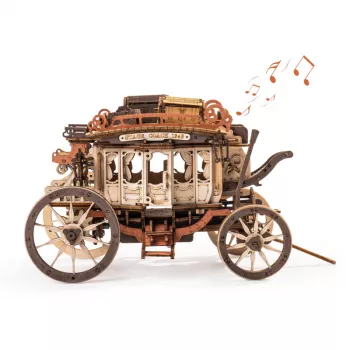
Build, Display, and Play: A Stagecoach Music Box You Assemble Yourself
A wooden stagecoach model that also plays music blends hands-on building with a keepsake display piece. The 3D Wooden Stagecoach Music Box Model is designed for hobbyists who enjoy assembling intricate wooden parts, then winding up a mechanism to bring a gentle melody to a finished, Old West–inspired stagecoach. It suits gift-giving for makers, collectors, and décor lovers, and it works well as a desk centerpiece once assembled. Below is a practical look at what it is, what the build is like, how the music mechanism typically functions, how to care for the finished model, and who tends to enjoy it most. For more guidance, see Stagecoach.
What it is
At its core, this is a 3D wooden model kit that becomes a stagecoach-shaped music box. Instead of being purely decorative, it’s meant to be handled: you build it, display it, and occasionally wind it up to enjoy the melody and the sense of mechanical motion. For many builders, the appeal comes from watching flat wooden sheets become a dimensional object with recognizable details like wheels, cabin contours, and travel-era styling. For further reading, see Mechanical Music – MBSI.org.
- A 3D wooden stagecoach model combined with a wind-up music box for motion and melody in one display item
- Intended as a buildable craft project that becomes a decorative piece when completed
- A gift-friendly option for people who like puzzles, models, and mechanical wooden builds
- Works as a conversation piece for shelves, desks, or themed décor (western, vintage travel, rustic)
Quick overview
| Detail | What to expect |
|---|---|
| Build type | 3D wooden model assembly (small parts, step-by-step construction) |
| Feature | Integrated wind-up music box mechanism |
| Best for | Teens and adults who enjoy crafts, models, and display builds |
| Use case | Gift, collectible display, light interactive décor |
| Care | Keep dry, dust gently, avoid direct heat/sunlight for long periods |
Why the stagecoach theme stands out
Stagecoaches carry a built-in sense of story. They suggest frontier travel, rugged routes, and a time when transportation felt tactile and mechanical—perfect inspiration for a wooden build with moving elements and music. Even as a compact display piece, the classic shape offers depth and visual texture, especially around the wheels and cabin lines.
- Stagecoaches evoke classic travel and frontier-era styling, making the finished model feel like a miniature historical vignette
- The silhouette—wheels, cabin, and harness details—creates visual depth even at small scale
- Pairs well with rustic, vintage, or library décor and complements other wooden mechanical models
- The music box element adds a nostalgic, heirloom-like quality beyond a standard static model
For a bit of background on music box history and how these mechanisms evolved, see Encyclopaedia Britannica’s overview of music boxes. For broader context on stagecoaches and early travel networks, Smithsonian Magazine regularly explores Americana and transportation topics that pair nicely with the theme.
Assembly experience: what builders typically enjoy
This type of kit tends to be most rewarding for people who like methodical progress. The build often starts with identifying and organizing pieces, then moving through structural steps (frame and body), and finishing with more visual details. The satisfaction comes not just from the finished look, but from how clean alignment can improve the feel of the completed mechanism.
- A satisfying progression from flat wooden pieces to a dimensional, functional object
- Fine details that reward patience—aligning parts cleanly improves both appearance and mechanism performance
- A relaxing, screen-free activity suited for evenings, weekends, or gifting as a build-together project
- A finished result that can be displayed immediately without needing additional framing or mounting
For a smoother build session, many hobbyists set up a tray or shallow box to prevent small parts from wandering, and they keep a microfiber cloth nearby to wipe away dust as they go. Taking short breaks helps too—especially right before installing any moving component.
Music box mechanism basics (what to know before buying)
Most wind-up music boxes rely on a spring-driven mechanism. Winding stores energy in the spring; when released, that energy turns the mechanism at a controlled pace so the melody plays. While the internal design varies by model, the user experience is typically the same: wind gently, set it on a steady surface, and let it play.
Gifting guide: who it’s best for
More gift ideas in stock
- VVS Moissanite Long Tassel Drop Earrings for a more elevated “occasion” gift pairing
- 70cm Kawaii Animal Plush Pillow for a cozy, playful companion gift
- Newborn Baby Gift Set – Bath Toys, Towels, Rattles & More when shopping for a family celebration
Display and care tips
When it makes sense to choose this model
For shoppers who want one item that feels personal, interactive, and display-worthy, the 3D Wooden Stagecoach Music Box Model hits that sweet spot.
FAQ
Is the 3D Wooden Stagecoach Music Box Model hard to assemble?
Difficulty mainly depends on your comfort with small parts and following step-by-step instructions. Working on a flat, well-lit surface and sorting pieces before starting usually makes the build feel much more manageable.
How does the music box part work after the model is built?
It typically uses a wind-up spring mechanism: winding stores energy, and releasing it plays the melody as the mechanism turns. Wind gently and stop when you feel stronger resistance to help protect the spring.
What makes this a good gift compared with a regular music box?
It adds the satisfaction of building something functional, not just receiving it fully finished. The stagecoach theme also gives it extra display character, so it feels like décor and a hands-on project in one.














Leave a comment